“Dear home,
What’s the one thing you would have me pack in the suitcase to always remember you?”
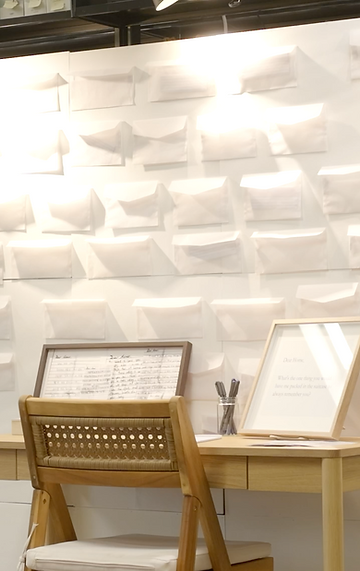
Within Her Suitcase: A Voyage of Women Immigrant Exhibition, an interactive corner titled "Letters to Home" was introduced. Visitors were invited to pause, take up a pen, and compose letters addressed to a country, a family, or a memory that continued to resonate. What was intended as a simple space for reflection unfolded into a deeply moving exchange.
Letters were written that carried readers across borders and generations: childhood memories from the Philippines, India, Korea, and Hong Kong. Recollections of food lovingly prepared, lullabies once sung, and rituals whose scents never faded were shared.


One letter, written entirely in Korean, was only partially understood through translation, yet the emotion was conveyed fully, a shared tenderness and longing were revealed.
Some letters were marked by joy and gratitude, while others carried the ache of distance, voicing what had been left behind. One particularly poignant letter came from a visitor reflecting on her childhood in the Philippines, where the uncertainty of home and identity was articulated:
"Home has become an unknown place for me. As an immigrant, I am questioning where home really is. It is Canada or is it the Philippines? Even if I have lived in Canada for quite some time, I still see myself as a young Filipina child roaming and running in the rivers and mountains of my hometown.
I do love Canada but my identity is unclear and I am confused. I love it here but I miss "home". But I don't know where it is anymore. I hope I find out one day. For now, if there's one thing I would pack in the suitcase to remember home, it would be seashells and dried flowers from the same field I used to run to."

- an excerpt from a letter written by a visitor
The resonance of such words was said to have echoed with Cheng herself, whose own coastal origins carried similar impressions of sea breeze, displacement, and the constant negotiation of belonging.
The letters, later displayed in half-transparent envelopes, allowed private words to be shared openly while still holding intimacy. Individually, each letter carried a singular narrative; collectively, they formed a chorus of voices. Intimate expressions made visible in a public space, echoing collective feelings of memory, loss, and homelessness.